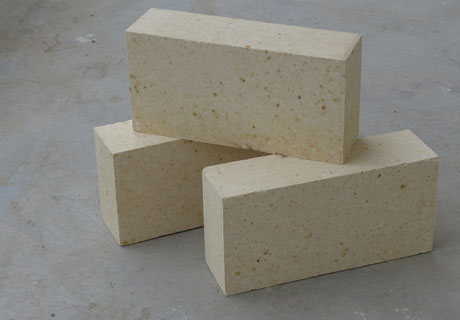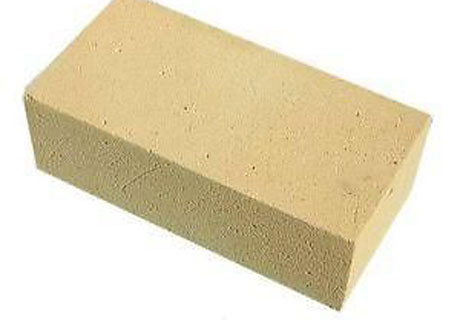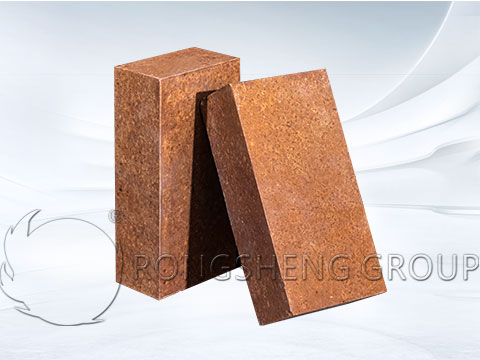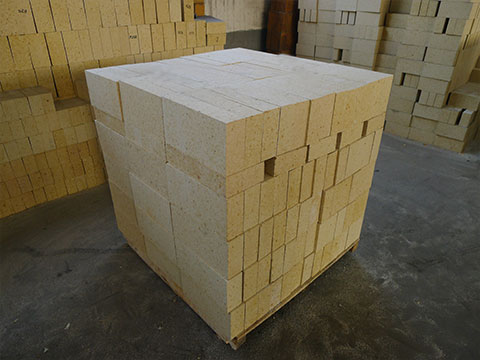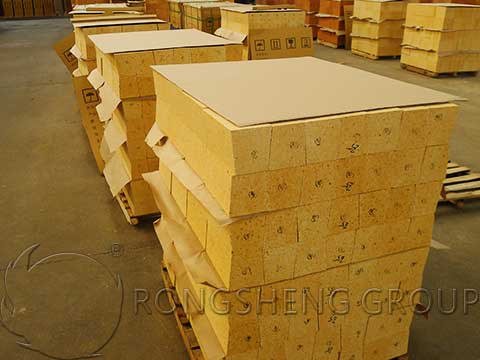
Mullite bricks, a type of high-alumina refractory brick, are refractory bricks with mullite as the main crystalline phase. They have a high load softening temperature, low high-temperature creep rate, good thermal shock resistance, and strong resistance to acidic slag erosion. Mullite bricks are classified into lightweight mullite bricks and heavyweight mullite bricks based on their bulk density. Lightweight mullite bricks are mainly used as insulation layers in industrial kilns in industries such as metallurgy, petrochemicals, building materials, and ceramics, including heating furnaces, soaking furnaces, heat treatment furnaces, tunnel kilns, roller kilns, and shuttle kilns. RS Mullite Refractory Brick Manufacturer recommends that the selection of refractory bricks for industrial kilns should primarily focus on meeting the needs of the kiln, and mullite bricks should be selected based on a comprehensive consideration of the kiln’s requirements. RS mullite refractory brick factory price.
What are the Characteristics of Corundum-Mullite Baffle Bricks?
Baffle bricks are widely used in burners of regenerative combustion technology, positioned between the burner bricks and the honeycomb ceramic regenerator. They serve to block the flame and provide fixation and protection for the honeycomb ceramic regenerator, significantly impacting and protecting its service life. This is especially true for honeycomb regenerative burners, whose compact structure makes it difficult to create space in the furnace wall or inside the burner to form a slag chamber or a channel to change the flue gas flow direction. Therefore, using baffle bricks in the high-temperature section in front of the burner reduces the radiation effect of high-temperature furnace gas on the front honeycomb ceramic regenerator and resists some of the erosion of the front honeycomb ceramic regenerator by iron oxide scale.
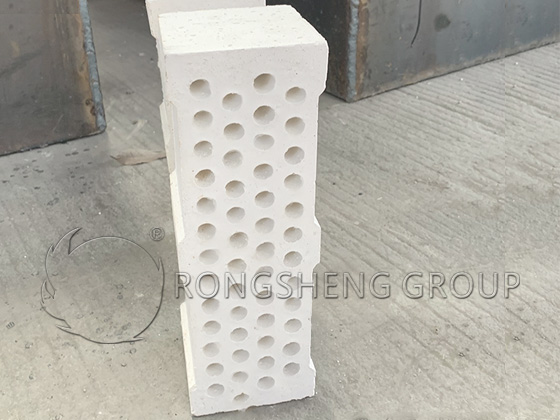
Corundum-mullite baffle bricks are mainly composed of high-alumina refractory materials with fused white corundum and synthetic mullite as the main crystalline phase. Its Al2O3 content is between 70% and 75%, it is white in color, and its refractoriness is above 1800℃. It features good thermal shock stability, high load softening temperature, strong resistance to chemical corrosion, and good thermal shock resistance. It can be used in conjunction with honeycomb ceramic regenerators in various regenerative combustion systems, specifically at the front end of the regenerator in regenerative industrial furnaces. It serves to baffle and fix the regenerator, extending its service life.
The front of the burner in the regenerator chamber of the industrial furnace uses baffle bricks, which can reduce the radiation effect of high-temperature furnace gas on the front regenerator and resist some of the erosion of the front regenerator by iron oxide scale. If the baffle bricks are improperly designed or installed, secondary combustion of high-temperature flue gas in the regenerator chamber can easily occur. This not only leads to easy burn-out of the baffle bricks and a short lifespan, but also causes problems such as cracking, collapse, melting, and softening of the regenerator honeycomb, negatively impacting the energy-saving effect and safe and stable operation of the entire regenerative combustion system.
Thermochemical Reaction of Mullite-Silicon Carbide Bricks with Harmful Alkaline Oxides
Mullite-silicon carbide refractory materials (referred to as silicon-mullite bricks) possess excellent wear resistance and thermal shock resistance, and are widely used in the transition zone of cement rotary kilns. Currently, the production process of silicon-mullite bricks mainly uses high-alumina bauxite with an alumina content of over 85% and silicon carbide as raw materials, which are formed by machine pressing and high-temperature firing.
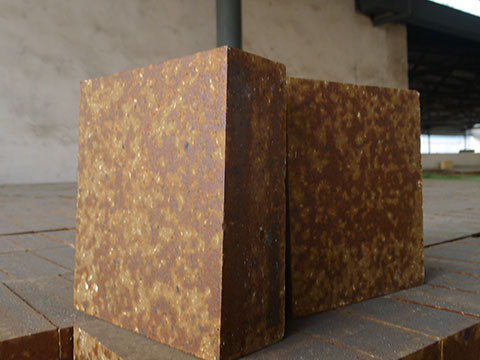
In recent years, cement rotary kilns have utilized waste and municipal solid waste as fuel or raw materials to produce cement, achieving “resource recovery and waste reduction” of waste, which is the future development direction of the cement industry. However, harmful alkaline oxides in these alternative energy sources form gaseous substances during combustion. As the service life of cement rotary kilns extends, these oxides accumulate inside, exacerbating the gas-phase erosion of the kiln lining refractory materials. For example, K(g) reacts with the mullite and corundum phases in silica-mullite bricks through chemical reactions according to formulas (1) to (3), forming nepheline (KAlSiO4) and leucite (KAlSi2O6). This reaction is accompanied by significant volume expansion, leading to the spalling and damage of the silica-mullite bricks.
2K(g) + 2Al6Si2O13 (s) + CO(g) =====2KAlSiO4 (s) + C(s) + 2SiO2 (s) + 5Al2O3 (s) (1)
2K(g) + 2Al6Si2O13 (s) + CO(g) =====2KAlSi2O6 (s) + C(s) + 5Al2O3 (s) (2)
2K(g) + 2KAlSi2O6 (s) + Al2O3 (s) + CO(g) =====4KAlSiO4 (s) + C(s) (3)
To improve the resistance of silica-mullite bricks to alkaline vapor erosion, improvements are generally made to their structure and composition. On the one hand, by introducing additives (Si, SiC, andalusite, etc.), the reaction volume expansion effect during the material preparation process is utilized to optimize the pore structure of silicon-mullite bricks, reduce the pore size of the bricks, inhibit the erosion of alkali vapors, reduce their penetration into the material interior, and improve their resistance to alkali erosion. On the other hand, by appropriately increasing the SiO2/Al2O3 (mass ratio) in the material matrix, a high-silica glass phase is formed within the material matrix during the preparation process, which is more easily transformed into a liquid phase [K2O·SiO2(l)] upon contact with alkali. This transforms the alkali erosion behavior from direct reactive erosion to dissolution-precipitation erosion, slowing down the erosion process and preventing large volume expansion, thereby significantly reducing the erosion rate of the material.
The Influence of Molding Process on the Performance of Mullite Insulating Refractory Bricks
Energy conservation in industrial kilns has always been a key issue that needs to be addressed by energy-intensive industries such as metallurgy, machinery, and chemicals. Using lightweight insulating materials with low bulk density and low thermal conductivity as furnace linings is one effective solution. Mullite insulating refractory bricks, due to their advantages such as low thermal conductivity, low heat capacity, high temperature resistance, good thermal shock resistance, high dimensional accuracy, and uniform structure, are suitable for lining the hot face and back of various industrial furnaces in metallurgy, petrochemicals, building materials, ceramics, and machinery. Because they can be in direct contact with flames, they are an extremely excellent insulating refractory material.
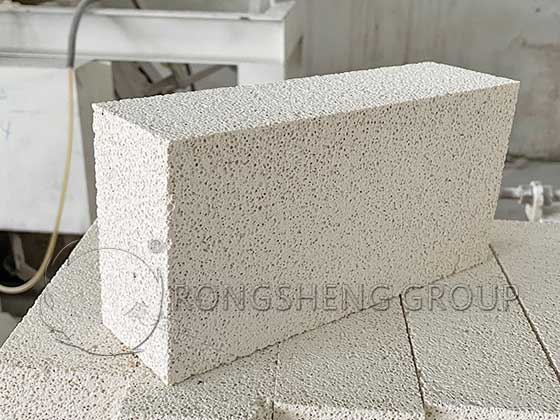
Mullite insulating refractory bricks achieve their lightweight and insulating effects primarily through the creation of pores within the material. Therefore, their preparation principle involves introducing pores into the material. Common methods include burnout material method, foam method, chemical reaction method, porous material method, gel casting method, freeze-drying method, and in-situ decomposition method. Among these, the burnout material method can be further divided into extrusion and machine pressing methods depending on the molding method. Different preparation processes have a significant impact on the performance of mullite insulating refractory bricks. To explore the influence of different processes on mullite insulating refractory bricks, experiments were conducted to prepare mullite insulating refractory bricks using three methods: machine pressing, extrusion, and foaming. The performance of these bricks was then compared.
By comparing the performance of lightweight mullite insulating bricks prepared using the three different molding methods, it can be seen that the mullite insulating bricks prepared using the foaming method have advantages such as better insulation performance, higher load softening temperature, better strength, and lower reheat linear shrinkage. Therefore, they exhibit significant advantages.