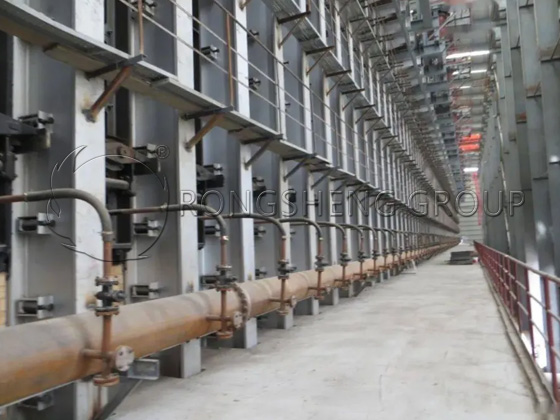
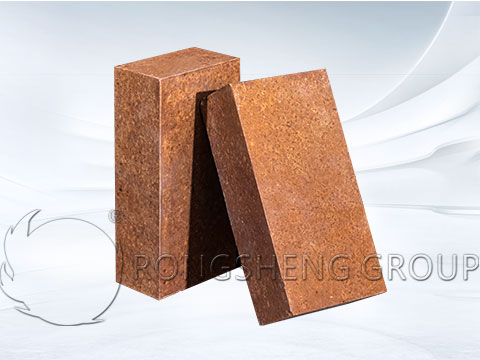
Over twenty years ago, silica refractory bricks were used as roof materials for electric arc furnaces. However, in China, high-alumina bricks or precast blocks are generally used. Because electric arc furnace roofs are subject to rapid temperature changes, slag buildup, flue gas erosion, and thermal radiation, the refractory materials used for the roof must possess excellent thermal shock resistance, erosion resistance, and high refractoriness. The refractory bricks used for furnace covers represent an evolution from silica bricks, high-alumina bricks, basic bricks, to monolithic refractories (large precast blocks).
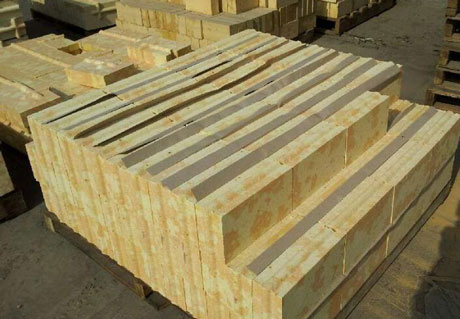
Silica Bricks Have Been Replaced
Due to their poor thermal shock resistance, silica bricks have only been used in furnace roofs for about 60 furnace cycles. In China, silica bricks have not been used for electric furnace roofs for over twenty years. Alkali refractory bricks also have inherent drawbacks, as they are unable to withstand the extreme temperature changes under ultra-high power conditions. Silica bricks and alkaline bricks have been replaced by high-alumina bricks, corundum bricks, high-alumina precast blocks, and castables. Especially for fully water-cooled furnace roofs, where refractory materials are only used in the central part, using precast bricks is labor-intensive and time-consuming. Poor mortar joints between bricks can lead to uneven stress distribution and reduced roof life. In recent years, large precast blocks made of high-strength castables have been used for furnace roofs, with over 1000 furnace cycles. In China, high-alumina bricks are commonly used for roofing, with a service life between 300-400 furnace cycles, which is 5-6 times that of silica bricks. However, high-alumina bricks and corundum castables are suitable for small furnace roofs. Currently, the use of large precast blocks for electric arc furnace roofs in China is increasing. This is because the integral furnace cover, with electrode holes left according to the shape of the roof, greatly reduces the complexity of the construction process. Furthermore, its service life is more than twice that of Grade 1 high-alumina bricks. However, precast integral furnace roofs are relatively expensive, and some smaller furnaces, due to budget constraints, often use high-quality high-alumina bricks for their roofs.
Silica Bricks are not Suitable for Electric Arc Furnace Roofs
With the development of monolithic refractory castables, ultra-low cement castables have been successfully used in electric arc furnace roofs. Using ultra-low cement castables in the triangular area significantly extends service life. Furthermore, the entire furnace roof is prefabricated as a single unit, achieving a lifespan of 600 heats, while smaller furnace covers exceed 1000 heats.
Generally, electric arc furnaces operate intermittently, with frequent rapid heating and cooling. Using silica bricks for the roof increases the frequency of replacements and production costs. Therefore, silica bricks are not suitable for electric arc furnace roofs.
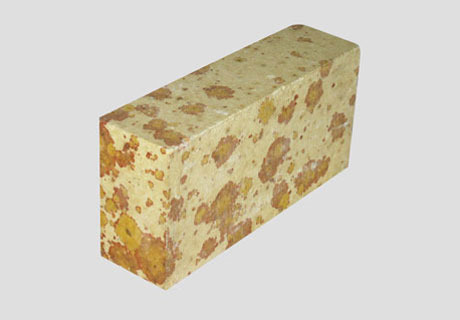
Applications of Silica Bricks
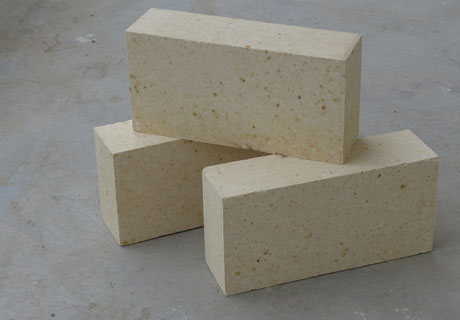
General Characteristics of Silica Bricks: Silica bricks are refractory products with silica as the main component, containing more than 93% silica. They are generally made from quartzite with a small amount of mineralizer added and fired at high temperatures. Silica bricks are acidic refractory materials with strong resistance to acid slag erosion. However, they are easily corroded by alkaline slag and are easily damaged by oxides containing Al2O3, K2O, Na2O, etc. Silica bricks, however, have good resistance to Ca, FeO, Fe2O3, and other oxides. A high-load deformation temperature is an excellent characteristic of silica bricks, fluctuating between 1640 and 1680℃. This expansion ensures tight joints in the masonry and guarantees good airtightness and structural strength. The main disadvantages of silica bricks are low thermal shock stability and low refractoriness (generally between 1690 and 1730℃), which limits their applications.
Silica bricks are mainly used in thermal equipment such as coke ovens, glass furnaces, and acid steel furnaces. The following two points should be noted when using silica bricks:
- When silica products are heated to 200-300℃ and 573℃, their volume will suddenly expand due to crystal transformation. Therefore, during baking, the temperature rise below 600℃ should not be too rapid, and drastic temperature changes should be avoided when cooling to below 600℃.
- Avoid contact with alkaline slag as much as possible.
Silica Bricks for Coke Ovens
Silica bricks for coke ovens are a type of silica refractory material used to construct coke ovens using quartz crystals. Coke oven silica bricks should possess the following characteristics:
- High softening temperature under load. Coke oven silica bricks should be able to withstand the dynamic loads of the coal charging car at high temperatures and remain undeformed over long-term use. Therefore, a high softening temperature under load is required for coke oven silica bricks.
- High thermal conductivity. Coke is produced by conducting heat through the combustion chamber walls of coking coal in the carbonization chamber. Therefore, silica bricks used to construct the combustion chamber walls should have high thermal conductivity.
- Good thermal shock resistance. Due to the periodic charging and discharging of coke in coke ovens, the temperature of the silica bricks on both sides of the combustion chamber undergoes drastic changes. Therefore, coke oven silica bricks are required to have good thermal expansion properties.
- High-temperature volume stability.
Silica Bricks for Glass Furnaces
Silica bricks for glass furnaces are a type of silica refractory material with quartz as the main component, used to construct high-temperature components of glass furnaces. Silica bricks used in glass furnaces should possess the following characteristics:
- High-temperature volumetric stability; the furnace body should not change due to temperature fluctuations.
- No contamination of molten glass.
- Resistance to chemical corrosion.
- Low bulk density.
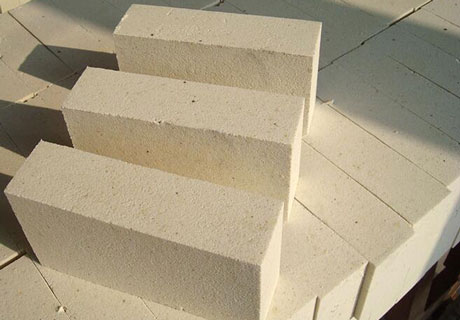
Performance and Applications of Lightweight Silica Bricks
Lightweight silica bricks are a very special material, belonging to the acidic category, with a silica content of over 92%. They are characterized by resistance to acidic slag erosion and high high-temperature strength. The softening temperature under load is 1450–1670℃. Furthermore, they do not deform under long-term use at high temperatures.
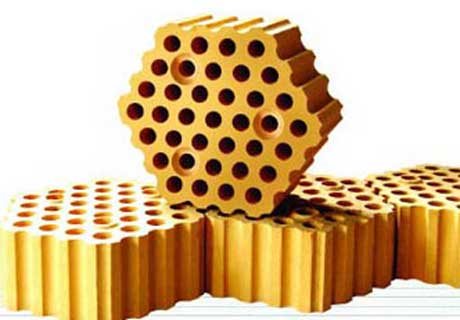
Lightweight silica bricks are also a type of lightweight insulating brick, with a higher heat resistance than lightweight clay bricks. Used in insulating areas, they reduce heat loss and increase the efficiency of the melting process. Lightweight silica bricks provide good insulation under the protrusions of the glass kiln arch. The insulation layer is designed in two or more layers. Lightweight silica bricks with a bulk density of 1.0 and 1.2 are commonly used, although 0.8 bulk density is also sometimes used. Lightweight silica bricks are paired with siliceous fire mortar.
Lightweight silica bricks are used in the blast furnace blast section, connected to the blast furnace exhaust fan. The operating temperature range for lightweight silica bricks is between 1000 and 1300℃. It can meet the entire cycle life requirements of a hot blast stove.
Lightweight silica bricks show no crystalline change above 600℃. They have a low coefficient of thermal expansion and high thermal shock resistance. Below 600℃, however, the crystalline transformation is significant, resulting in large volume changes and decreased thermal shock resistance. Lightweight silica bricks are made from natural silica with added mineralizers, and are slowly fired at 1350–1430℃ in a reducing atmosphere.
Lightweight silica insulation bricks are also used in the partition walls of the carbonization and combustion chambers of coke ovens, the regenerators and slag chambers of open-hearth steel furnaces, soaking furnaces, glass melting furnaces, and firing kilns for refractory materials and ceramics. They are also used in the vaults and other load-bearing parts of kilns. Furthermore, they are used in the high-temperature load-bearing parts of hot blast stoves and the roofs of acidic open-hearth furnaces.