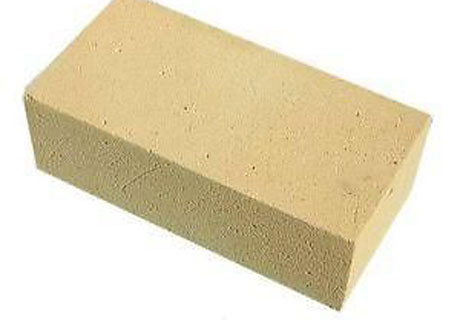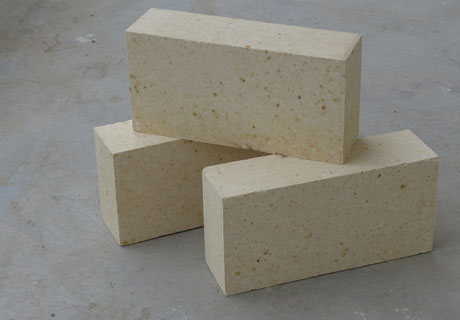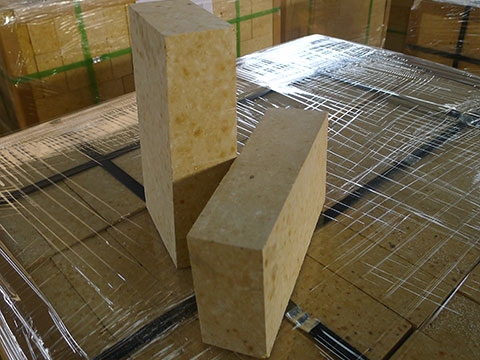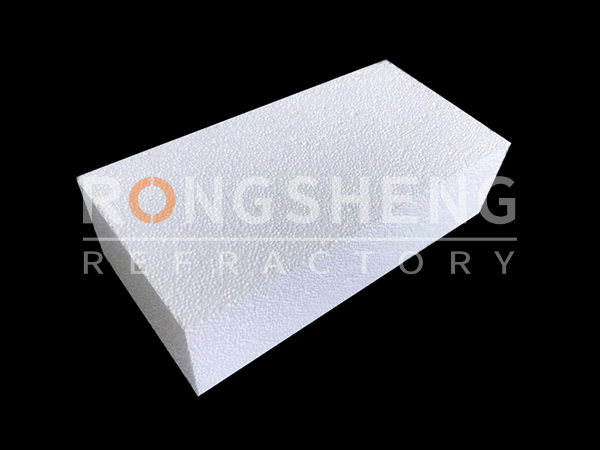
Energy-saving and consumption-reducing products play a crucial role in the field of refractory materials, and one such product is insulating refractory material. Insulating refractory materials are lighter than ordinary refractory materials of the same composition; hence, they are generally also called lightweight refractory materials. Studies have shown that using insulating refractory materials to construct furnaces and other thermal equipment can save 2/5 to 3/5 of energy compared to using ordinary refractory materials. Furthermore, the lighter weight of the furnace and the thinner wall allow for reduced energy consumption, achieving the goal of “energy saving and consumption reduction.”
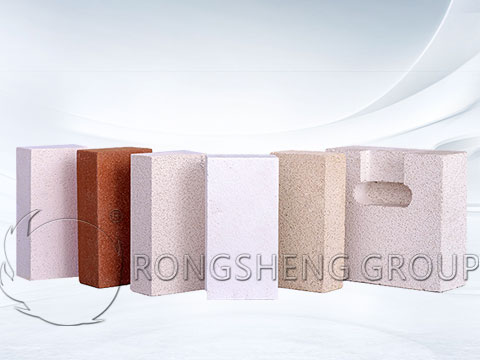
Thermal Insulating Refractory Materials
With the advancement of science and technology, the manufacturing technology and varieties of thermal insulating refractory bricks materials have developed rapidly. From the perspective of the production process, the preparation of thermal insulating refractory materials almost encompasses all methods of producing refractory materials.
Temperature insulating refractory materials are an important component of the refractory material system. Due to its special structure, its porosity is not less than 45%. While almost all refractory materials pursue high density, this material pursues low density with a certain strength. Therefore, in terms of the production process, in addition to the traditional or special processes of refractory materials, there are various manufacturing processes for thermal insulating refractory materials, such as methods to reduce the bulk density of the product and increase the porosity.
Types of Thermal Insulating Refractory Materials
There are many classification methods for thermal insulating refractory materials, and these methods vary from country to country. Several commonly used classification methods are as follows:
- (1) Classified by bulk density: The bulk density of thermal insulating refractory materials is generally not greater than 1.3 g/cm3, with some requiring 1.5 g/cm3. The bulk density grades of commonly used heat-insulating refractory materials are: 0.6 g/cm³; 0.8 g/cm³, 0.9 g/cm³, and 1.0 g/cm³. Refractory materials with a bulk density not exceeding 0.4 g/cm³ are also called ultra-lightweight heat-insulating refractory materials.
- (2) According to the service temperature: Refractory materials with a service temperature below 900℃ are low-temperature heat-insulating refractory materials, such as diatomaceous earth bricks. Refractory materials with a service temperature of 900~1200℃ are medium-temperature heat-insulating refractory materials, such as lightweight clay bricks and alumina fiber products. Refractory materials with a service temperature above 1200℃ are high-temperature heat-insulating refractory materials, such as lightweight silica bricks and alumina bubble bricks.
- (3) According to the chemical and mineral composition of the raw materials: clayey, silicate, high-alumina, corundum, diatomaceous earth, expanded perlite, alumina fiber, etc.
- (4) According to the form of the material, it is divided into: shaped heat insulation products, unshaped heat insulation materials, granular heat insulation materials, fiber heat insulation materials, and composite heat insulation and refractory materials, etc.
Insulation Principle
Industrial furnaces and kilns constructed with general refractory materials typically have an energy utilization rate of less than 30%. Thermal conductivity is an essential metric for the design of high-temperature thermal equipment. Using thermal insulation materials to construct furnaces and kilns can reduce wall thickness and heat loss. In steady-state heat conduction, the Fourier formula is:

In the formula, Q is the heat transfer area; F is the heat transfer area; t is the heat transfer time; dT/dt is the temperature gradient; and λ is the thermal conductivity.
As is well known, the larger the λ value, the greater the heat transfer. 1/λ is called thermal resistance, which represents the ability to impede heat transfer. The greater the thermal resistance, the lower the temperature of the outer surface of the furnace wall, and the less heat loss. Choosing a material with a small λ value reduces heat loss. The λ value of a gas is much smaller than that of a solid. Therefore, the porosity of a material can significantly reduce its λ value, thus requiring heat-insulating refractory materials to have high porosity. The higher the porosity, the smaller the λ value. An approximate quantitative relationship is:

In the formula, P represents porosity.
Furthermore, pore size also has a certain influence on the λ value. At low temperatures, the thermal conductivity of insulating refractory materials decreases with increasing pore size, while above 800℃, especially above 1000℃, the thermal conductivity increases rapidly with increasing pore size. Therefore, insulating refractory materials with small pore sizes are preferred at high temperatures, while those with large pore sizes are preferred at low temperatures. The microstructure of insulating refractory materials can be categorized into three types based on the existence and distribution of the solid and gas phases:
- (1) Insulating materials where the gas phase is continuous, and the solid phase is dispersed;
- (2) Insulating materials where the solid phase is continuous, and the gas phase is dispersed;
- (3) Insulating materials where both the gas and solid phases are continuous.
At the same porosity, the microstructure with a continuous gas phase has a lower thermal conductivity than that with a continuous solid phase, and the thermal conductivity of fibers and products is even lower. For ultralight fiber materials, a smaller density does not necessarily mean a smaller λ value. Rather, there is a specific density at which the λ value is minimized; this density is called the optimum density. The optimum density increases with increasing temperature.
Due to differences in chemical and mineral composition, the thermal resistivity of various refractory materials varies greatly in their solid phase. Generally, the more complex the crystal structure, the lower the thermal conductivity. Therefore, to manufacture thermally insulating refractory materials—that is, refractory materials with a small λ value and high thermal resistance (1/λ)—it is essential to select suitable materials and manufacture refractory materials with high porosity.
Refractory Materials for the New Energy Industry
The new energy industry’s demand for refractory materials is mainly concentrated in areas requiring special properties such as high temperature, high corrosion resistance, and lightweight. Corundum mullite bricks and alumina bubble bricks are key products.
Corundum Mullite Bricks
- Product Introduction: Refractory products composed of corundum and mullite as the main crystalline phases. They possess good high-temperature strength, high-temperature creep resistance, thermal shock resistance, and corrosion resistance.
- Applications: Primarily used in high-temperature hot blast stoves and also in glass kilns.
Alumina Bubble Bricks
- Product Introduction: Made primarily from alumina hollow spheres and alumina powder, combined with other binders, and fired at 1750 degrees Celsius. They belong to the category of ultra-high temperature energy-saving and heat-insulating materials.
- Applications: High-temperature energy saving (>30%) in downdraft kilns, shuttle kilns, molybdenum wire furnaces, tungsten rod furnaces, induction furnaces, nitriding furnaces, etc. They significantly reduce furnace weight, modify structures, save materials, and conserve energy.
RS Refractory Brick Manufacturer
RS Refractory Brick Manufacturer specializes in providing refractory bricks, insulating bricks, high-pure alumina bubble bricks, and heat-insulating ceramic fiber materials for the lining of high-temperature industrial furnaces. Our products are reliable in quality, have a long service life, and help businesses save energy, reduce consumption, and lower costs. Contact RS Refractory Brick Manufacturer for free samples and quotations.