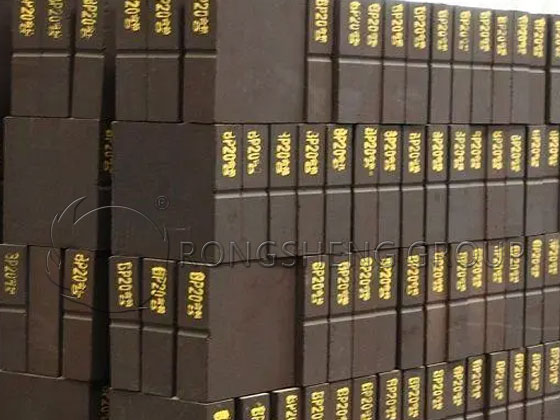
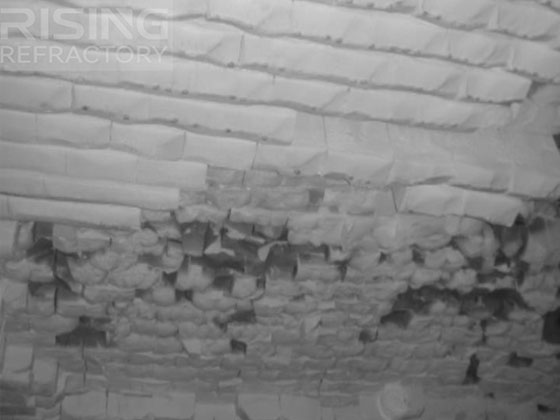
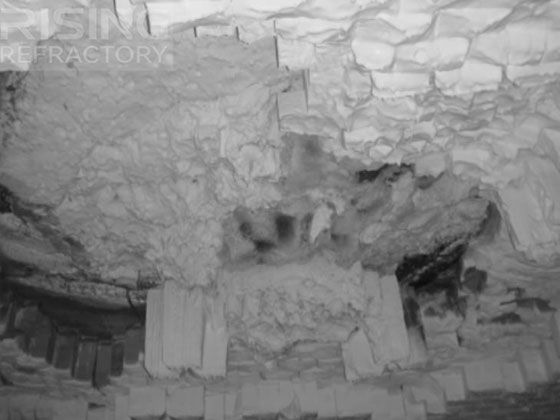
This is an analysis of an actual case involving the fracturing and detachment of silica bricks at a glass manufacturing plant. In an 89 m² melting furnace, a collapse occurred in the furnace crown, creating a hole approximately 1 m² in size, more than a year after the furnace had been heated up and put into operation. An inspection following the furnace shutdown revealed that many of the crown bricks surrounding the collapse had fractured into two pieces; in each case, one half had already fallen into the furnace, while the remaining half was all that held up the furnace crown, as shown in Figure 1.
Why did the Furnace Crown Collapse?
The facility is newly constructed, and some of the operating personnel lack a high level of technical proficiency; there are few experienced workers. Compounded by factors such as coal quality, the gasifiers frequently experience “dead” zones (stagnant combustion) or even the burning out of air nozzles (tuyeres), necessitating the activation of a backup gasifier. On the day before the crown collapse was discovered, issues with coal quality and operational practices caused a significant drop in furnace temperature—from 1545°C down to approximately 1200°C—which persisted for an extended period. Furthermore, the maintenance personnel failed to timely adjust the tensioning bolts (tie-rods) for the main arch crown, causing the crown to contract as it cooled. Because the tensioning bolts were not tightened to compensate for this substantial contraction, the entire crown structure settled downward, as illustrated in Figure 2. This resulted in the arch bricks opening up at their lower edges, leading to the bricks slipping out or falling. During the subsequent reheating phase, the crown expanded; the forces exerted between the bricks intensified. However, because the bricks surrounding those that had already fallen were left with reduced contact surfaces and unevenly distributed loads, they became loose, ultimately triggering a large-scale collapse of the crown.
Why do Crown Bricks in a Glass Furnace Break into Two Pieces?
One significant reason is that, during the furnace heat-up (drying-out) process, the facility’s drainage system had not yet been completed. Heavy rainfall occurred, and a large volume of water poured onto the furnace crown, completely soaking the aluminum silicate fiber insulation boards—to the point where, in some areas, water was actually leaking out of the insulation. At this stage, the furnace crown had reached nearly 200°C—a critical point for crystalline phase transformation. The sudden drop in temperature on the outer surface of the crown created a substantial temperature differential between the inner and outer surfaces of the silica bricks. Furthermore, silica bricks have poor thermal stability (typically withstanding only 1–4 thermal cycles); this induced significant internal stress, causing the bricks to crack and split into two, thereby creating a serious latent defect in the furnace crown. When bricks were later observed falling from the crown—eventually leading to a large hole—this scenario was considered, though it could not be confirmed at the time as that specific area was not directly observed. However, photographs taken after the furnace was shut down clearly show the crown bricks broken into two pieces, confirming that the damage was caused by the rain during the heat-up process; the silica bricks had already cracked and fractured at that time. Subsequent temperature fluctuations (cooling and reheating cycles) caused the crown bricks to loosen, which was the direct cause of them falling out. Since the bricks were already fractured, any movement or change in the furnace crown caused the broken pieces to fall away, resulting in a collapse that left a large hole in the furnace crown.
Proper Use of Silica Bricks in Glass Furnaces
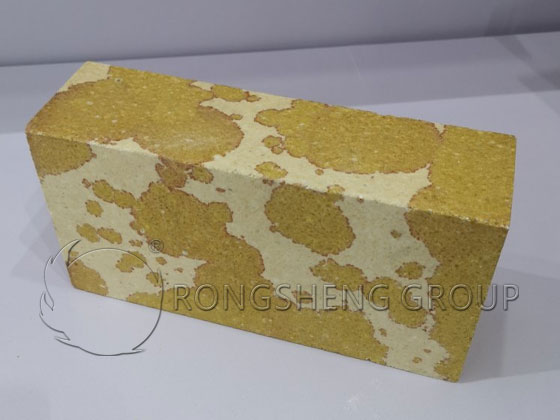
Silica bricks are a common type of refractory brick used in glass furnaces. However, they possess poor thermal shock resistance and low thermal conductivity. Furthermore, because the crystalline form of SiO2—and consequently its volume—changes with temperature, the heating curve during the furnace-drying (or “curing”) process must not be too rapid; otherwise, the resulting volume expansion can cause the bricks to crack.
To maintain the structural integrity of the silica bricks, it is necessary to implement “holding periods” (isothermal stages) during the heating process—specifically at the temperature ranges where the internal crystalline transformation of the SiO2 occurs—to minimize the temperature differential between the inner and outer surfaces of the bricks. It should be noted that the transformation temperatures for SiO2 crystalline forms are typically determined in a laboratory setting, which may differ from actual industrial conditions. First, laboratory-grade SiO2 crystals are highly pure, whereas industrial silica bricks contain mineralizers that can shift these transformation temperatures. Second, laboratory temperature-measurement instruments offer higher precision than those typically available in industrial production environments; therefore, some degree of discrepancy is inevitable. Additionally, as silica bricks are poor thermal conductors, they exhibit significant thermal resistance, resulting in a slow rate of heat transfer.
To address these challenges, we employ a “slow heating” strategy by incorporating holding periods at critical temperatures, effectively creating broader temperature ranges for the transitions. This approach minimizes the impact of variations in crystal purity and the limitations of temperature-measurement precision. To further reduce the temperature gradient across the bricks, we apply insulation to the furnace crown (arch) while the furnace is still cold, leaving only a strip approximately 1 meter wide in the center uninsulated. Once the furnace-drying process is complete, this remaining section is insulated and covered with aluminum silicate fiber boards. This method helps minimize temperature differentials while still allowing for inspections.
As the internal temperature of the furnace rises and the bricks expand, the tensioning bolts on the crown or the tie-rods on the vertical columns must be adjusted promptly. This prevents the brickwork from “creeping” or expanding excessively upward, which could lead to cracking. If these tensioning components are not loosened in a timely manner, gaps may form between the crown bricks, causing the contact between adjacent bricks to shift from “surface contact” to “line contact.” The entire weight of a brick is concentrated along the points or lines of contact, resulting in exceptionally high localized pressure. This uneven distribution of force can, in severe cases, crush the edges or corners of the bricks, thereby compromising their structural integrity. Under such “line contact” conditions—compounded by factors like undersized arch bricks, insufficient mortar beneath them, or weak mortar adhesion—a brick may shift out of position (“slip”) and fall. Consequently, extra vigilance is required during the kiln-drying (heating-up) process, with timely adjustments made to the arch-crown tensioning bolts or the tie-rods on the vertical support columns.
Once the kiln-drying process is complete, the arch bricks make “surface-to-surface” contact with one another. This ensures an optimal distribution of force across the entire arch and provides an effective seal. Such a configuration is more resistant to erosion by alkaline dust or vapors, and it minimizes damage to the brick joints caused by flame-induced burning, chemical erosion, or mechanical scouring.