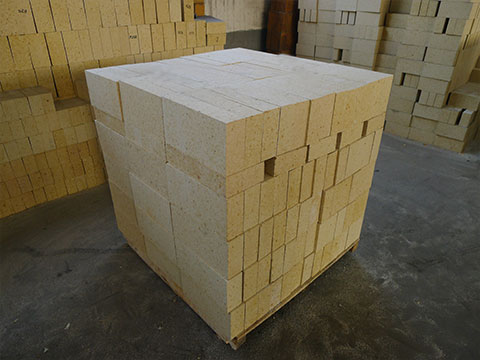
In the lining design of vertical lime kilns and rotary kilns, increasing the thickness of high-alumina refractory bricks is a common technical measure used to extend service life. Thicker brickwork effectively reduces the number of mortar joints and enhances resistance to abrasion and erosion, thereby improving the overall durability of the lining. However, such an approach requires careful consideration of factors—including equipment type, operating conditions, and economic performance—and must be implemented within reasonable parameter ranges to achieve an optimal balance between service life and production efficiency.
Technical Benefits of Using Thicker High-Alumina Bricks in Lime Shaft Kilns
Increasing the thickness of high-alumina bricks in lime shaft kilns offers significant technical and economic advantages:
- Optimization of Structural Performance
Thicker bricks result in fewer mortar joints, thereby reducing the number of structural weak points. Furthermore, the increased thickness provides greater resistance against wear and erosion, significantly enhancing the durability of the lining, extending its service life, and reducing the frequency of repairs.
- Analysis of Production Benefits
While using thicker bricks slightly reduces the internal diameter of the kiln—leading to a marginal decrease in production output—practical experience shows that this loss is relatively minor. The overall benefits gained from an extended service life and lower maintenance costs far outweigh this reduction. Consequently, many operators have found the use of thicker bricks to be a viable solution that effectively controls total production costs.
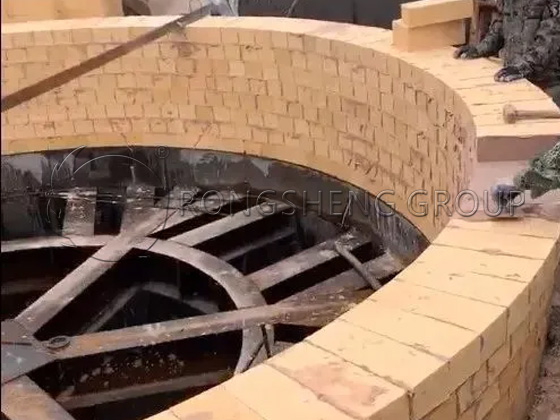
Special Considerations for Increasing Refractory Lining Thickness in Rotary Kilns for Lime Calcination
Unlike vertical kilns, the thickening of high-alumina brick linings in rotary kilns must be strictly controlled. This is primarily due to the following factors:
- Dynamic Load Constraints
Rotary kilns operate in a state of continuous rotation. Increasing the thickness or length of the refractory bricks significantly adds to the weight of the lining, thereby increasing the load on the kiln shell. This leads to higher energy consumption and accelerated mechanical wear. Comprehensive analysis indicates that thickening the lining beyond an optimal range ultimately results in a decline in overall operational efficiency.
- Dimensional Parameter Control
The thickness and length of refractory bricks used in rotary kilns must be maintained within an appropriate range. Current industry practice often involves using different types of materials for the high-temperature zone and the transition zone; however, regardless of the material selected, any adjustments to brick dimensions must adhere to the principle of moderation.
Typical Dimensions and Practical Applications
- Selection of Length Specifications
In practical applications, high-alumina bricks with a length of 345 mm are more commonly used, while the 230 mm specification is employed less frequently. This preference is based on a comprehensive assessment of structural stability and construction convenience.
- Control of Thickness Specifications
For vertical kilns, the thickness of high-alumina bricks is typically increased to a range of 20–25 mm, resulting in a total thickness of approximately 100 mm. In the case of rotary kilns, due to the constraints imposed by their rotational operation, a brick thickness of 220 mm is generally standard; increasing this thickness further would lead to excessive lining weight and a significant reduction in production capacity, and is therefore not advisable.
Increasing the thickness of high-alumina bricks is an effective technical strategy for extending the service life of lime kilns, though its implementation must remain reasonable. For vertical kilns, a moderate increase in thickness can optimize both technical and economic performance. For rotary kilns, however, the extent of any thickness increase must be strictly controlled to prevent the lining from becoming too heavy, which would otherwise impair the operational efficiency of the equipment.
In summary, adjustments to brick dimensions should be based on a scientific evaluation of equipment characteristics, operating conditions, and overall costs, aiming to strike an optimal balance between enhanced durability and sustained production efficiency.
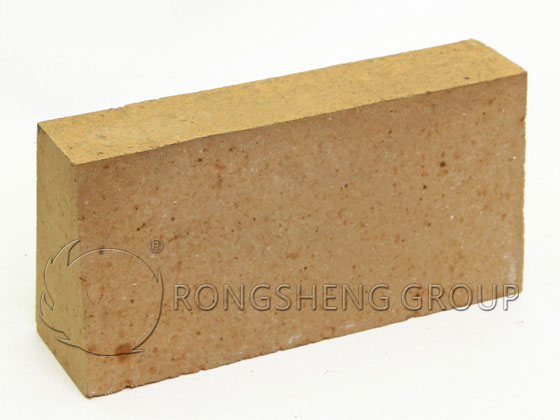
High-Alumina Bricks for Lime Kilns
High-alumina bricks are a critical lining material for lime kilns, as they are highly effective at withstanding the high temperatures, mechanical wear, and chemical erosion present within the kiln environment.
| Characteristic/
Parameter |
Description or Typical Values | Reference Standard or Source |
| Al₂O₃ Content Classification | Grade I: >75%; Grade II: 60–75%; Grade III: 48–60% | Industry-standard classification |
| Refractoriness | Generally above 1770°C (typically 1750–1790°C); classified as a high-grade refractory material | Product characteristic description |
| Refractoriness Under Load (RUL) | Approximately 1400°C to over 1550°C; increases with higher Al₂O₃ content (e.g., LZ-55 ≥ 1400°C, LZ-75 ≥ 1500°C, LZ-80 ≥ 1510°C, LZ-85 ≥ 1530°C) | Physical and chemical specifications |
| Compressive strength at room temperature | Typically ranges from 50 MPa to over 80 MPa (e.g., Grade III bricks ≥ 50 MPa, Grade I bricks ≥ 70 MPa, and special-grade bricks ≥ 80 MPa). | Physical and chemical specifications of the product |
| Apparent Porosity | Generally required to be in the range of ≤21% to ≤24% (higher Al₂O₃ content typically corresponds to a lower required apparent porosity; for example, LZ-55 is ≤24%, while LZ-85 is ≤20%). | Physical and Chemical Specifications of the Product |
| Bulk Density (g/cm³) | Approximately 2.2 to 2.75 or higher (e.g., Grade 3 bricks ≥ 2.2, Grade 1 bricks ≥ 2.5, high-purity bricks ≥ 2.75). | Physical and Chemical Specifications of the Product |
| Slag Resistance | Classified as a neutral refractory material, it can resist erosion from both acidic and basic slags; however, due to its SiO₂ content, its resistance to basic slag is relatively weaker. | Product Characteristic Description |
Common Applications of High-Alumina Bricks in Lime Kilns
In lime kilns, high-alumina bricks are used in various sections, depending on their grade and specific properties:
Preheating Zone: Although temperatures in this zone are relatively lower, the material begins to undergo preheating and is subject to a certain degree of abrasion. Grade II or Grade III high-alumina bricks are commonly used here.
High-Temperature Transition Zone: Characterized by significant temperature fluctuations, this area requires materials with excellent thermal shock resistance and high mechanical strength. High-alumina bricks (typically of a higher grade) are a common choice for this section.
High-Temperature Zone: Located adjacent to the firing zone, this area experiences high temperatures and frequent thermal fluctuations, demanding exceptional refractoriness and volume stability. High-alumina bricks (typically of a higher grade) are well-suited to meet these rigorous conditions.
Cooling Zone (Post-Firing): While temperatures are lower here, the lining must still withstand elevated heat as well as mechanical erosion from the material. Thanks to their wear resistance and refractoriness, high-alumina bricks are also suitable for this area.
Kiln Lining, Kiln Roof, Burner Surroundings, and Discharge Ports: These critical components of a lime kiln are directly exposed to high-temperature flames and materials, or are subjected to significant structural loads and abrasion; high-alumina bricks are essential in these areas to provide necessary protection.
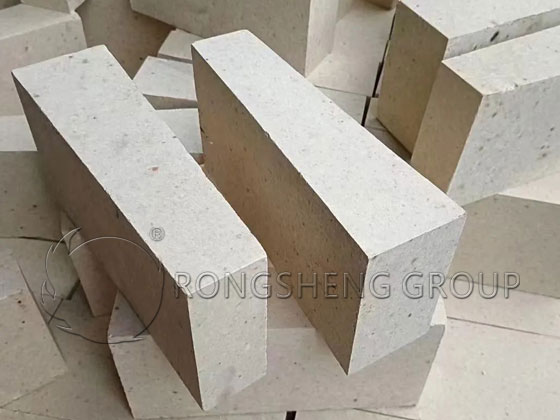
Considerations for the Selection and Use of High-Alumina Bricks
To ensure that high-alumina bricks perform optimally and achieve a long service life within a lime kiln, the following points require special attention:
- Proper Selection is Fundamental: The grade and type of high-alumina bricks must be chosen based on the specific operating temperatures, atmosphere, wear conditions, and budget of the lime kiln. For instance, bricks with a higher Al₂O₃ content generally offer superior high-temperature performance, though they also come at a higher cost. In critical high-temperature zones, it is advisable to use products with a higher refractoriness-under-load (softening temperature) and better volume stability at high temperatures.
- Ensure Quality in Masonry: Lining construction must strictly adhere to design requirements and technical specifications. The surface of the kiln shell should be thoroughly cleaned, and an appropriate refractory mortar—compatible with the brick material—must be used. Ensure that brick joints are uniform and densely filled, and employ staggered joint patterns to enhance overall structural stability. It is also essential to incorporate proper expansion joints.
- Prioritize the Kiln Drying-Out Process: Following the construction or major overhaul of a kiln, it must undergo a slow drying-out process—guided by a pre-established heating curve—before any raw materials are introduced. This allows moisture within the refractory materials to be gradually removed, preparing them for operational conditions and preventing cracking caused by rapid heating.
- Regular Inspection and Maintenance: During routine operation, the kiln should be shut down periodically for inspections to check the high-alumina brick lining for wear, erosion, or cracking. Any localized damage should be repaired or replaced promptly to prevent issues from escalating and compromising the integrity or service life of the entire kiln lining.
Thanks to their exceptional refractoriness, high-temperature strength, excellent resistance to erosion, and relatively good thermal shock stability, high-alumina bricks serve as an indispensable material for lime kiln linings. Selecting the appropriate grade of high-alumina bricks and ensuring proper installation and usage are crucial for maintaining the stable operation of a lime kiln, extending the lifespan of its lining, and enhancing production efficiency.