Focus on Producing All Kinds Of High Quality Refractory Fire Bricks !
Application of Magnesia-Chrome Refractory Bricks in RH/RH-OB Furnaces
The RH/RH-OB lining is used under vacuum-sealed conditions, where the vent pipes, inlets, bottom, and oxygen ducts are subjected to the maximum molten steel circulation velocity. Therefore, its initial erosion mechanism is likely the cracking of the refractory material near the hot face, leading to corrosion. Based on the operating conditions of RH/RH-OB, it is estimated that the lining will experience structural fractures or weakening throughout all processes. Specifically, this manifests in the following ways:
(1) Between preheating and molten steel treatment, rapid heating or cooling of the hot face causes thermal shock damage; the greater the temperature difference, the greater the damage.
(2) Due to changes in oxygen pressure and/or temperature, Fe+2/Fe+3 oxides circulate alternately. The refractory chromite and chromite spinel phases, as well as the iron oxide absorption zone, are affected by this, causing damage to the lining.
(3) The melting of the usual refractory bonding phase provides a channel for slag intrusion, allowing slag penetration (particularly sensitive to silicate bonding), leading to erosion of the directly hot face portion of the iron oxide absorption zone enriched with iron oxide. When considering all relevant temperatures, a large amount of liquid phase will form wherever the iron oxide content exceeds 30%. Therefore, in such cases, even in areas of the lining less affected by molten steel contact with the circulating molten steel, such as the upper part of the lower cylinder sidewall (excluding the oxygen tuyeres), partial liquefaction will occur, leading to corrosion of the liquid surface area.
(4) Because of slag penetration, the hot-face erosion front forms cracks close to the interior, so some damage may be the result of partial hot-face spalling. This type of lining damage is usually discontinuous (discontinuous type). Due to the relatively rapid advance of the erosion front and the peeling ability of the flowing molten steel, the spalling loss rate in severely eroded areas is larger (progressive damage).
Application of Magnesia Chrome Bricks in the Industrial Kiln
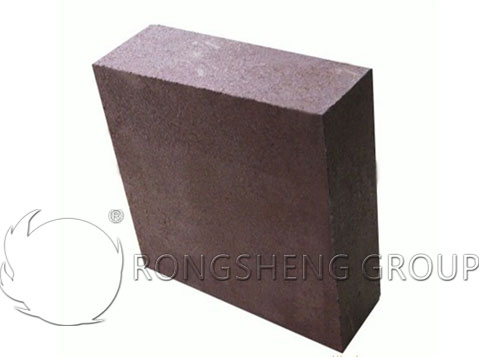
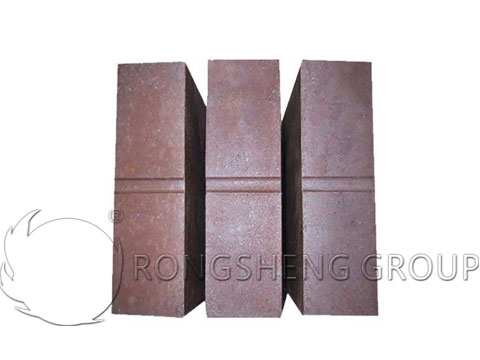
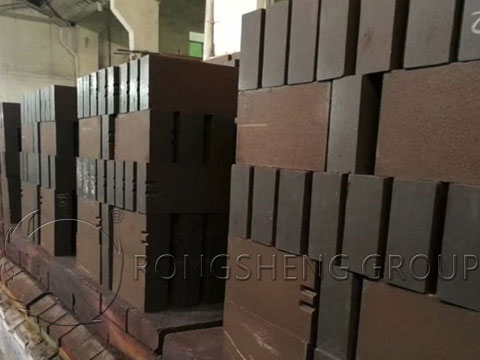
Magnesia-Chrome Bricks Used in the Working Lining of RH/RH-OB Furnaces
Based on the aforementioned corrosion mechanism of the working lining in RH/RH-OB units, the refractory materials used for the working lining are typically direct-bonded magnesia-chrome bricks or basic rammed monolithic linings. Different zonal linings are used according to the different usage conditions and product quality requirements of different parts, forming a comprehensive inner lining.
Under these conditions, the selected magnesia-chrome bricks should meet the following requirements:
(1) Minimal degradation in strength and microstructure when subjected to thermal shock during use.
(2) Slag penetration is difficult, and even if penetration occurs, the bonding between particles and the required strength are maintained.
(3) High resistance to spalling.
The properties of magnesia-chrome bricks are related to the degree of development of secondary spinels formed on the grain boundaries, and are also affected by the chemical composition of the magnesia-chrome bricks on the formation of secondary spinels.
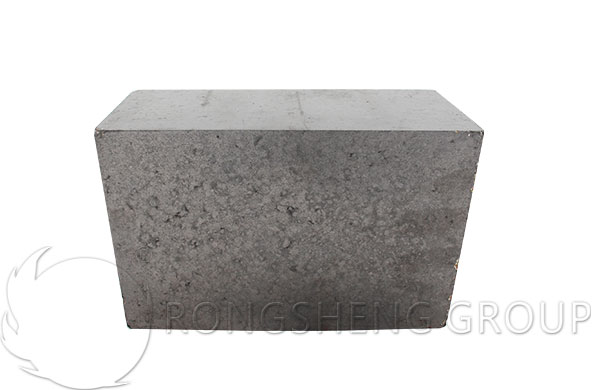
Magnesia-chrome bricks used in RH/RH-OB units include traditional direct-bonded magnesia-chrome bricks, rebonded magnesia-chrome bricks, semi-rebonded magnesia-chrome bricks, and special composite magnesia-chrome bricks. Among these, the best Cr2O3 content is found in special composite magnesia-chrome bricks with a Cr2O3/MgO ratio of 0.2~0.4. These products exhibit typical characteristics.
Mamesia-chrome bricks are a type of special composite direct-bonded magnesia-chrome brick with sintered magnesia-chrome sand as particles and periclase and chromium as the bonding matrix. Magnesia-chrome bricks B and D are semi-rebonded and rebonded magnesia-chrome bricks, respectively. Magnesia-chrome brick A is a traditional and relatively ideal direct-bonded magnesia-chrome brick. It has the best thermal shock resistance but the worst erosion resistance. Rebonded brick D has the best erosion resistance but suffers the greatest thermal shock damage. Semi-rebonded brick B and special composite brick C have moderate erosion resistance and better thermal shock resistance than brick D. Among them, the special composite high-chromium brick C has the best combination of various properties, ranking second in both erosion resistance and thermal shock resistance, with low porosity and high strength.
In addition, traditional direct-bonded magnesia-chrome bricks are mainly high-temperature fired magnesia-chrome bricks. In the production of magnesia-chrome bricks, the reaction between chromite and periclase has been studied using high-grade chromite and near-single-crystal fused MgO as raw materials, and the following conclusions were drawn:
(1) The Cr2O3 component in the chromite dissolves in fused MgO, releasing spinel with (Mg, Fe, Al, Cr)2O4 components. The content of each R2O3 in the spinel varies depending on the chemical composition of the chromite used. R2O3 readily dissolves into the interior of MgO in the order of Fe2O3>Al2O3>Cr2O3. However, the solubility of each R2O3 increases in the order of Cr2O3>Fe2O3>Al2O3 near the contact surface with the chromite.
(2) In chromite, SiO2 reacts with MgO to form a liquid phase primarily composed of SiO2 and MgO. A higher SiO2 content results in a greater amount of liquid phase formation. Furthermore, it has been confirmed that SiO2 promotes liquid phase formation. Moreover, similar to the etching of fused MgO, the liquid phase extends into the interior.
Therefore, it can be concluded that even high-grade chromite (high Cr2O3 content) with a high SiO2 content is unsuitable as a raw material for high-temperature fired direct-bonded magnesia-chrome bricks used under harsh conditions.
Because the content of iron oxides is greatly affected by oxygen pressure, the Fe2O3 content in the magnesia-chrome bricks used as linings in RH/RH-OB units should also be controlled.
Adding a certain amount (e.g., 13%) of sintered chromium spinel sand (5~0.5mm) to magnesia-chrome bricks to produce composite magnesia-chrome bricks can yield magnesia-chrome refractories composed of heterogeneous multiphase materials. It was also found that there is a direct bond between sintered chromium spinel particles and fused periclase fine powder, while the direct bond between fused granular magnesia-chrome material and periclase fine powder is less pronounced. Therefore, it is easy to deduce that sintered chromium spinel refractories bonded with fused MgO will exhibit higher volume stability and corrosion resistance under vacuum conditions, as well as under conditions of drastic temperature fluctuations, atmospheric changes, and slag erosion, compared to refractories primarily composed of fused magnesia-chrome material or sintered chromium spinel.
Methods to Improve the Performance of Magnesia-Chrome Bricks
To improve their performance, the following technical measures can be adopted:
(1) Select high-purity magnesia sand and high-purity (very low SiO2) chromite as raw materials and increase the proportion of chromite to produce high-quality magnesia-chrome bricks with a high Cr2O3/MgO ratio.
(2) Add a certain amount of Cr2O3 powder or ultrafine chromite powder to promote the sintering of magnesia-chrome materials and obtain high-quality magnesia-chrome bricks with well-developed secondary spinel.
(3) Add appropriate amounts of Fe-Cr and other metal powders. Through their oxidation during firing, the porosity of magnesia-chrome bricks is reduced, and a microporous structure is formed in the matrix.
(4) Fire magnesia-chrome bricks in an oxidizing atmosphere under ultra-high temperature conditions, and then slowly cool them after firing to obtain a microstructure with well-developed secondary spinel crystals.
(5) Adding a certain amount of special additives with a lower thermal expansion coefficient than magnesia-chrome bricks, or additives such as CaCO3 (0.1~2.0 mm) and ZrO2, can improve the thermal stability of magnesia-chrome bricks.
By adopting the above measures, high-quality magnesia-chrome bricks with high-temperature strength, excellent erosion resistance, and high thermal stability can be produced.