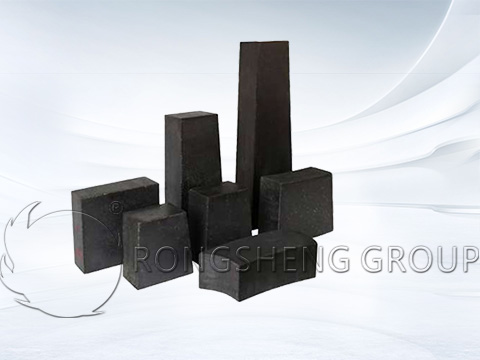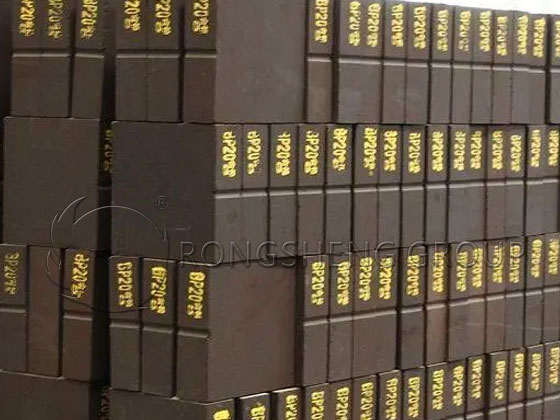
In recent years, with the development of the glass industry and increasingly stringent environmental protection requirements, glass electric melting furnaces have been rapidly promoted both domestically and internationally due to their high thermal efficiency, energy savings, improved working conditions, and the elimination of the need for desulfurization and denitrification equipment and regenerator investment. They are now widely used in the production of optical glass, borosilicate glass, lead glass, fluoride glass, bottle and jar glass, and fiberglass, and the technology has matured. Fused cast zirconia alumina bricks, with their superior resistance to molten glass erosion and low pollution, have become the most critical furnace-building material in electric melting furnaces, directly contacting the molten glass phase. However, the higher the temperature of the fused zirconia alumina bricks, the lower their resistivity, leading to particularly severe erosion around the fused cast zirconia alumina in the electrode brick area (especially the upper part), becoming a bottleneck affecting the lifespan of the electric melting glass furnace.
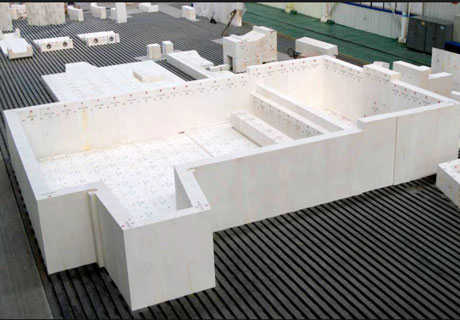
Performance Characteristics of Fused Cast Zirconia-Corundum Bricks
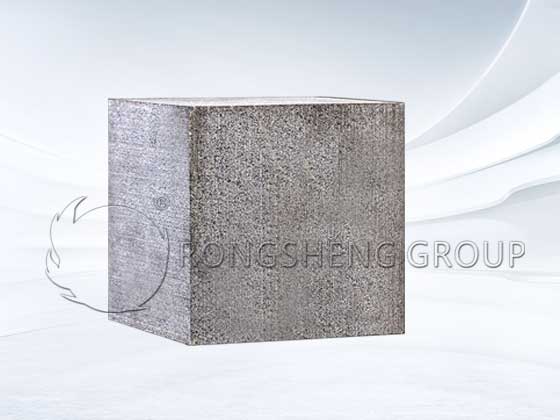
Fused cast zirconia-corundum bricks are produced by oxidizing and melting raw materials such as alumina, alkali powder, and zircon sand at high temperatures, casting them into a mold, holding them at heat for annealing, and then cooling them to form the final product. Typically, the bricks contain 31–45 wt.% ZrO2, 9–14 wt.% SiO2, and 0.6–1.9 wt.% Na2O, with Al2O3 used to make up the balance. During the solidification process of the molten liquid, according to the Al2O3-ZrO2-SiO2 ternary phase diagram, ZrO2 primary crystals first precipitate from the molten liquid. When the ratio of ZrO2 to Al2O3 in the zircon-corundum eutectic structure is reached, a zircon-corundum eutectic framework structure is formed. Finally, SiO2, Na2O, and Al2O3 form a glassy phase. Small amounts of impurities such as K2O, CaO, Fe2O3, and TiO2 also enter the glassy phase, filling the spaces between the zircon-corundum eutectic framework and relieving the zircon phase transformation stress. During the use of fused zircon-corundum bricks, the glassy phase in the brick partially seeps out at high temperatures, forming pores. The glass infiltrates within the furnace and replaces the residual glassy phase in the contact layer of the fused brick. Simultaneously, the zircon-corundum eutectic typically melts into the molten glass at the same rate. At high temperatures, the resistivity of ZrO2 crystals and the glassy phase is low, while the electrical properties of the zircon-corundum eutectic are close to those of corundum, with a higher resistivity. Based on the analysis of the erosion and conductivity mechanisms of fused bricks, introducing a small amount of special oxides into the glassy phase of the fused brick can increase the resistivity and high-temperature viscosity of the glassy phase, thereby increasing the amount of zircon-corundum eutectic and potentially improving resistivity and erosion resistance.
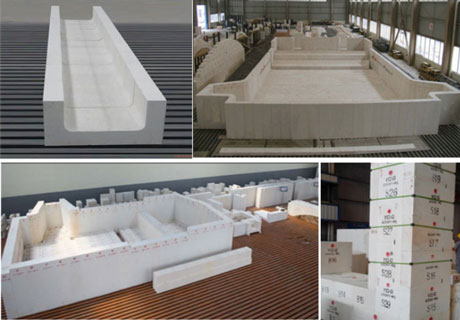
Advantages and Applications of High-Resistivity Fused Zirconia-Corundum Bricks
Based on considerations of improving the resistivity and high-temperature viscosity of the glass phase, we rationally designed the chemical composition of high-resistivity fused zirconia-corundum bricks, controlling its composition to meet the requirements of fused zirconia-corundum refractories for glass melting furnaces. Through experimentation, adjustment of the manufacturing process, and improvement of casting yield, we developed high-resistivity and corrosion-resistant fused zirconia-corundum bricks. SiO2, Al2O3, and Na2O are the main components of the glass phase in fused zirconia-corundum bricks, determining the content and properties of the glass phase. Reducing the Na2O content can reduce the alumina content in the glass phase and increase the SiO2 content, thereby increasing the resistivity of the glass phase. Simultaneously, the content of Fe2O3 and TiO2 should be controlled to be as low as possible. Adding a small amount of special oxides has a certain influence on the crystal structure of fused zirconia-corundum materials. These special oxides can act as nuclei for zircon and corundum crystals or form solid solutions, increasing the proportion of the eutectic phase and thus improving the resistivity of the brick at high temperatures. Based on batch casting tests using multiple ingredient combinations, and considering factors such as production process, product appearance quality, and physicochemical properties, the optimal formula and manufacturing process for high-resistivity fused cast zirconia-alumina bricks were selected.
The resistivity of No. 41 high-resistivity fused cast zirconia-alumina bricks at high temperatures of 1000℃~1600℃ is approximately 3~8 times that of ordinary No. 41 fused cast zirconia-alumina bricks, and its erosion rate is about 30% lower than that of ordinary No. 41 high-resistivity fused cast zirconia-alumina bricks. In practical applications in electrofused glass furnaces, the surface temperature of the bricks near the electrodes was found to be 20~50℃ lower than that of ordinary No. 41 fused cast zirconia-alumina bricks. The actual erosion situation in the furnace was significantly improved, thus demonstrating broad prospects for widespread application.
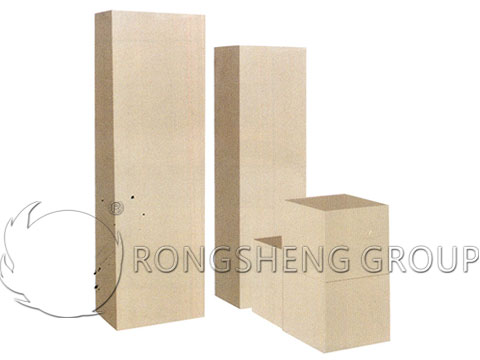
Research on the Performance Characteristics and Application of Electroformed Refractory Bricks in Blast Furnace Linings
Previously, electroformed bricks were mainly developed for use in glass kilns. Recently, their application as a material in ironmaking and steelmaking has attracted attention. Electroformed magnesia-chrome bricks have been used on the side walls of electric furnaces, and have also been used on the lower side walls and bottom of degassing containers, showing good results. Electroformed alumina refractories are particularly effective in the lower part of the blast furnace body and the belly, where damage is most severe. The quality parameters of electroformed alumina are as follows:
- (1) Purity: Excludes high-glassy substances.
- (2) High density, low porosity, and almost no permeability to gases.
- (3) High thermal conductivity: Type A electroformed bricks have four times the thermal conductivity of clay bricks.
- (4) Shallow slag penetration and excellent resistance to alkali erosion.
The results of slag erosion tests show that compared with ordinary sintered refractories, it has an extremely thin impregnation layer. The results of alkaline substance erosion tests show that electroformed bricks exhibit stronger erosion resistance than sintered high-alumina bricks. Due to this characteristic, electroformed bricks are used in blast furnace linings.
Besides α- and α/β-type refractory bricks, alumina-zirconia form is currently being tested. α-alumina has high thermal conductivity, α/β-alumina exhibits strong resistance to alkaline erosion, and alumina-zirconia refractory bricks have excellent slag resistance. Perhaps α-alumina is an excellent refractory brick material for blast furnaces. In summary, the test results of electroformed refractories for blast furnace linings being tested in various countries are of utmost concern.
α-alumina and K₂O react relatively easily at low temperatures to form β-alumina. This is accompanied by rapid expansion and embrittlement. We believe that this reaction is limited to the surface layer of the refractory working surface. Therefore, it is not fatal. However, the possibility of further reaction during long-term use cannot be ruled out.
In the experiment, its damage was very small compared with other refractory bricks. After two years of use, the porosity of the refractory bricks increased, and it changed from α type to β type. The intrusion of alkaline substances could be seen, and the damage rate was greater than expected.