Focus on Producing All Kinds Of High Quality Refractory Fire Bricks !
How to Select Suitable Long-Life Refractory Materials based on the Principle of AOD Furnace?
The basic principle of the AOD process is to reduce the partial pressure of CO by diluting the gas. The introduction of a high-pressure argon-oxygen mixture increases the contact between the molten steel and the bubbles and slag, which is beneficial for the rapid removal of carbon, sulfur, and non-metallic inclusions. During the smelting process, the composition and properties of the slag in the AOD furnace change significantly, with the basicity varying from approximately 0.6 initially to 4.0–4.5 later. The refractory materials are subjected to erosion from the highly corrosive acidic slag to the basic slag. The main causes of refractory material damage include: eddies generated by gas stirring, causing violent turbulence and scouring of the molten steel and slag; high refining temperatures (1700–1750℃) and large temperature fluctuations, leading to thermal spalling and structural spalling; and slag with large basicity changes at high temperatures, causing penetration and erosion of the furnace lining. Therefore, refractory materials used in AOD furnaces should possess high high-temperature strength, good thermal shock resistance, slag resistance, and resistance to erosion.
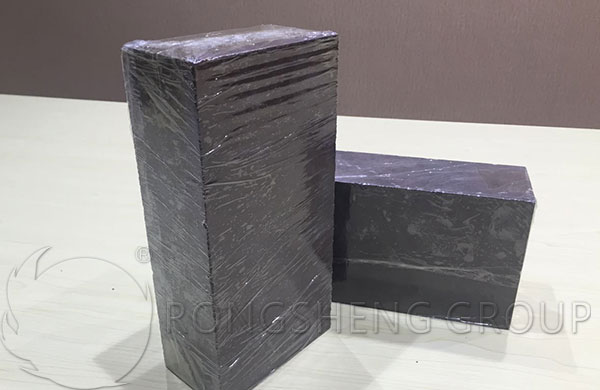
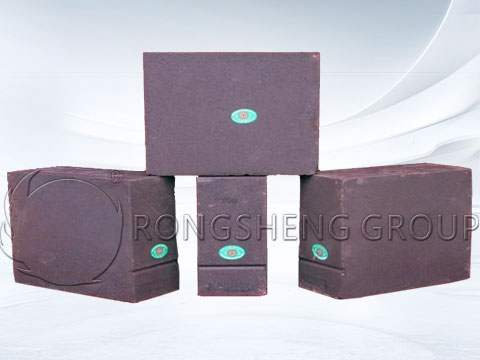
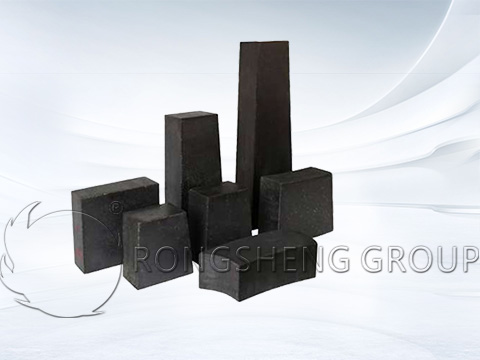
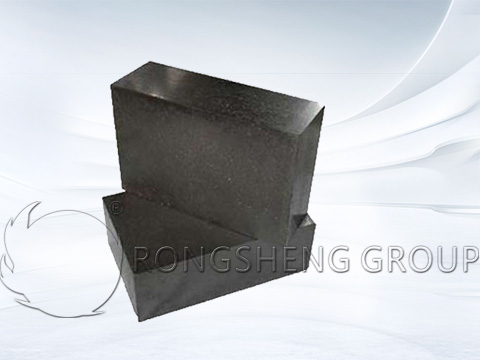
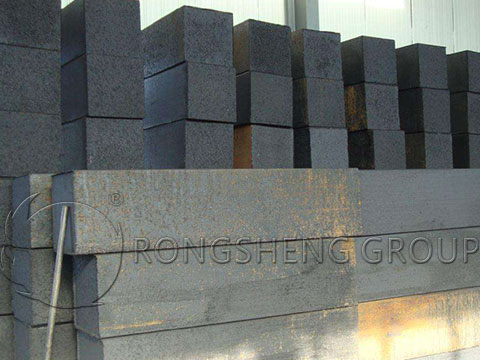
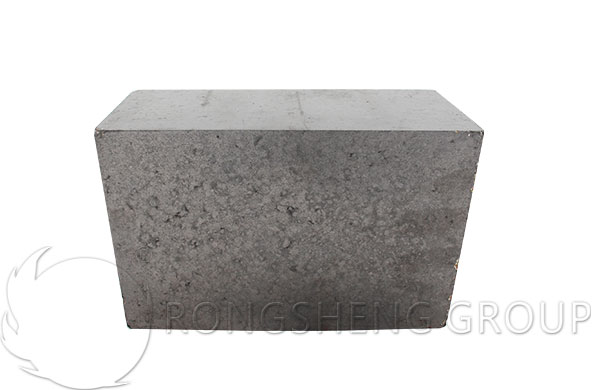
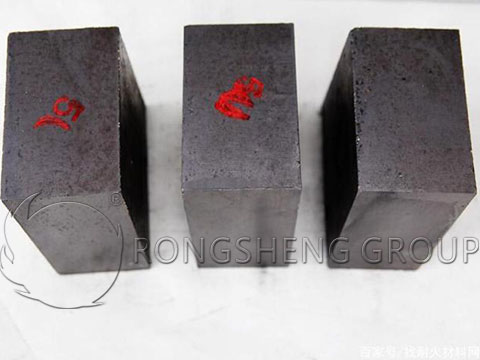
Rongsheng Direct-Combination of Magnesia Chrome Brick in RS
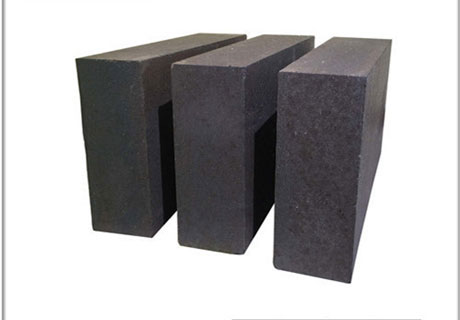
Directly Bonded Magnesia-Chrome Bricks for AOD Furnace Lining
AOD furnace linings are generally constructed using directly bonded MgO-Cr2O3 bricks, rebonded MgO-Cr2O3 bricks, and semi-rebonded MgO-Cr2O3 bricks. Directly bonded MgO-Cr2O3 bricks are made from high-quality, high-purity magnesia and refined chromium ore, calcined at high temperatures. Their microstructure is characterized by direct bonding between the main crystalline phases, while the low-melting-point silicate phase exists in isolation. Rebonded MgO-Cr2O3 bricks are made by crushing fused magnesia-Cr2O3 and then firing it at high temperatures. They are characterized by excellent slag resistance and better performance than directly bonded MgO-Cr2O3 bricks. Semi-rebonded MgO-Cr2O3 bricks combine the properties of both directly bonded and rebonded MgO-Cr2O3 bricks, offering even better performance.
Causes of Damage to Magnesia-Chrome Bricks Used in AOD Furnaces
The main concern is the structural spalling caused by slag infiltration, leading to brick deterioration. To improve their performance, the following aspects should be considered in the production of magnesia-chrome bricks:
(1) Strict control of chemical composition. The Cr2O3 content (by mass fraction, the same below) should ideally be 18%–20%. The SiO2 content has the greatest impact on resistance to erosion and should be kept as low as possible, preferably <1%. Simultaneously, the CaO content should be strictly controlled.
(2) The particle size distribution should be rationally controlled during the brick-making process, and high-pressure molding and ultra-high-temperature firing should be employed.
Magnesium-Calcium Series Refractory Materials
Magnesium-calcium series refractory materials have received widespread attention due to their abundant raw materials and low price, but defects such as easy hydration limit their widespread application. The main types used in AOD furnace linings are calcined magnesia-dolomite bricks and electrofused uncalcined magnesia-dolomite bricks. Calcinated magnesia-dolomite bricks are made from high-quality sintered magnesia-dolomite sand as the main raw material, formed under high pressure, and fired at temperatures above 1600℃. Fused unburned magnesia dolomite bricks are made from fused magnesia dolomite sand, formed under high pressure and dried at low temperature. Because the fused magnesia dolomite sand is fully smelted, has a complete crystal lattice, and low reactivity, fused magnesia dolomite bricks exhibit high resistance to erosion and hydration.
Selection of Refractory Materials for AOD Furnaces
Magnesium-chromium (MgCr) and magnesium-calcium (MgC) series refractories are the main refractory materials used in AOD furnaces. Considering the service life of AOD furnaces with different refractory linings, each material has its advantages. Taking all factors into account, magnesium-calcium series refractories are more advantageous, and their application in AOD refining furnaces has become a development trend.
When selecting refractory materials for AOD furnaces, the following standards must be met:
In terms of thermal stability, they must be able to withstand sudden high-temperature thermal shock and possess good heat resistance and thermal shock resistance. They must ensure that no severe thermal spalling or thermal cracking occurs during a wide range of temperature changes.
In terms of corrosion resistance, they must withstand the erosion of various high-temperature chemical substances inside the furnace, while ensuring good thermochemical stability over a wide range of basicity changes.
In terms of mechanical properties, they must possess excellent mechanical shock resistance and wear resistance to resist the frequent impact and wear of the violently turbulent eddies of the molten steel and slag mixture. The United States, which traditionally uses magnesia-chrome bricks as the main furnace lining material, has also focused on developing magnesia-calcium series refractories in recent years.
This is because magnesia-calcium series refractories have unique advantages:
(1) Their main components, MgO and CaO, have high melting points (2800℃ and 2570℃, respectively), low vapor pressure, and stable thermodynamic properties.
(2) The dihedral angle of the MgO-CaO bond is larger than that of the MgO-MgO bond, which is beneficial for improving resistance to slag penetration and slag erosion. Magnesia-calcium series materials have better thermal shock resistance than magnesia-chrome series materials.
(3) The presence of CaO can purify molten steel, making it particularly suitable for smelting pure steel.
(4) Raw material resources are abundant and inexpensive, and there is no chromium pollution.
Magnesia-chrome sand, a refractory raw material for directly bonded magnesia-chrome bricks.
Directly bonded magnesia-chrome bricks are widely used in cement kilns and high-temperature kilns in the steel industry. Synthetic magnesia-chrome sand is the main raw material for producing directly bonded magnesia-chrome bricks. Using a sintering synthesis process, employing synthetic magnesia-chrome sand to produce directly bonded magnesia-chrome bricks not only makes full use of my country’s abundant magnesite resources but also lowers the firing temperature.
The synthetic magnesia-chrome sand used to produce directly bonded magnesia-chrome bricks is made from natural magnesia raw materials such as magnesite, light-burned magnesia powder, and chromite. It is formulated according to design requirements, finely ground, briquetted, and calcined, or obtained through electrofusion, resulting in a raw material with magnesia-chrome spinel as the main component.
In the manufacture of sintered magnesia-chrome sand, light-burned magnesia powder and selected chromite are formulated according to design requirements, further ground, briquetted, and then calcined at 1700-1900℃ in an oxidizing atmosphere to obtain calcined magnesia-chrome sand. Electrofused magnesia-chrome sand is made from light-burned magnesia powder and selected chromite, formulated and melted. Fused magnesia-chrome sand exhibits well-developed crystals, a dense structure, low porosity, and a high degree of direct bonding. Therefore, fused cast rebonded magnesia-chrome bricks possess excellent corrosion resistance and are widely used in applications with extremely harsh corrosion conditions. However, the thermal shock resistance of fused cast rebonded magnesia-chrome bricks is inferior to that of directly bonded magnesia-chrome bricks made from magnesia and chromite.
The chromite used in refractory materials belongs to the aluminum chromite (MgFe)(CrAl)₂O₄ type, generally containing 30%–60% w(Cr₂O₃), and the iron oxide content (calculated as Fe₂O₃) should be less than 14%. The content of impurities such as SiO₂ and CaO should be minimized to reduce the formation of low-melting-point substances such as iron spinel and tetracalcium aluminoferrite. Synthetically produced magnesia-chrome spinel sand has a more complex mineral composition, and its properties vary considerably. Based on the different formation methods, it can be divided into sintered magnesia-chrome sand and fused magnesia-chrome sand.