Focus on Producing All Kinds Of High Quality Refractory Fire Bricks !
Key Points for Purchasing and Using High-Alumina Refractory Bricks
In industrial high-temperature refractory masonry systems, high-alumina bricks are widely used and well-suited to various operating conditions. Compared to ordinary clay bricks and lightweight insulating bricks, high-alumina bricks offer significant advantages in core properties such as high-temperature resistance, erosion resistance, thermal shock stability, and load softening. Compared to high-end materials like corundum and silicon carbide, they also offer good adaptability and cost-effectiveness. Therefore, they are widely used in the lining structures of various medium- and high-temperature kilns in metallurgy, building materials, power, and chemical industries.
Many industrial kilns experience problems such as lining spalling, high-temperature deformation, slag penetration, and structural loosening, primarily due to a mismatch between the refractory brick material grade and the actual operating temperature and media conditions. High-alumina bricks, with their moderate performance range and stable physicochemical structure, are suitable for most conventional medium- and high-temperature complex operating conditions, making them a core foundational masonry material for industrial furnace construction.
Production and Operating Characteristics of High-Alumina Bricks
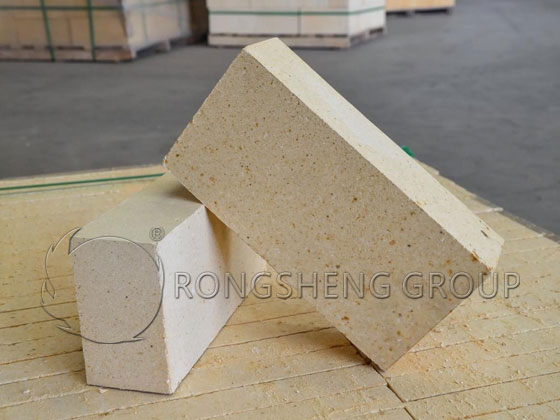
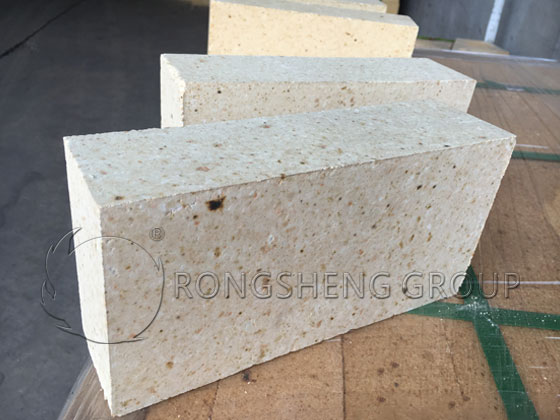
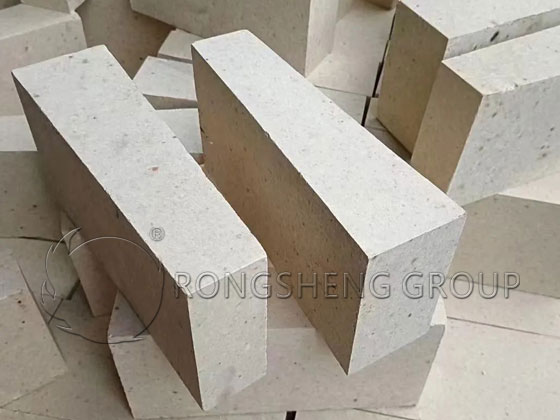
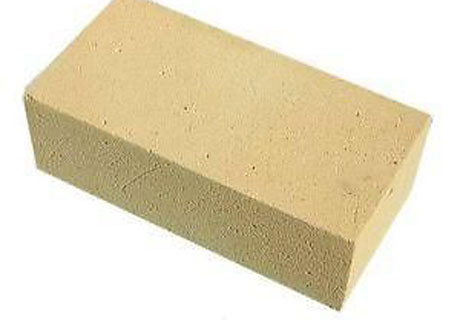
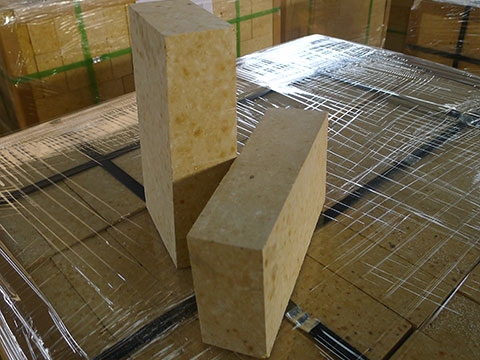
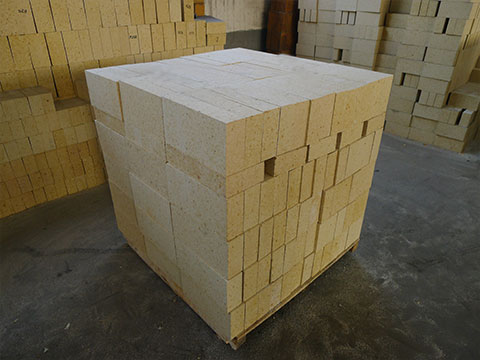
High-alumina bricks are made primarily from high-alumina bauxite clinker, combined with appropriate binders, through crushing, high-pressure pressing, and high-temperature sintering. Their core performance is determined by the alumina content; the higher the alumina content, the stronger the material’s refractoriness, high-temperature structural strength, and erosion resistance. The finished bricks have a dense structure, uniform pore distribution, and regular dimensions, exhibiting the typical structural stability of shaped refractory materials. After installation, they form a robust, sealed, and temperature-resistant integral furnace lining system.
From an operating condition compatibility perspective, high-alumina bricks are typical neutral refractory products, not reacting violently with most acidic or weakly alkaline media, and have a wide atmosphere compatibility range. Their conventional operating temperature range covers 1200℃ to 1600℃, meeting the operational requirements of most continuous and intermittent high-temperature kilns and adapting to mainstream industrial medium- and high-temperature operating conditions.
Clay refractory bricks have a lower upper temperature resistance limit and limited high-temperature load stability, making them suitable for medium- and low-temperature insulation and auxiliary flue applications. Lightweight insulating bricks prioritize thermal insulation but have weak structural strength and erosion resistance, making them unsuitable as working layers in load-bearing or erosion-prone areas. Corundum and silicon carbide bricks offer superior temperature resistance and corrosion resistance, but at a higher cost. High-alumina bricks, on the other hand, combine high-temperature resistance, structural strength, erosion resistance, thermal shock stability, and cost-effectiveness, making them the preferred material for medium- and high-temperature furnace linings.
First, stable high-temperature resistance. They possess high refractoriness and a high load softening temperature, making them resistant to softening and deformation during long-term operation at medium to high temperatures, thus stably supporting the furnace structure and high-temperature loads.
Second, excellent thermal shock resistance. They exhibit excellent resistance to alternating hot and cold temperatures, making them suitable for intermittent production modes with frequent kiln start-ups and shutdowns and large temperature fluctuations, and less prone to large-area cracking and spalling.
Third, balanced resistance to media erosion. They possess good resistance to high-temperature flue gas, slight slag, and dust erosion. The dense brick structure effectively blocks media penetration, protecting the furnace lining base structure.
Fourth, high structural strength and good integrity. The dense and hard bricks have high compressive strength, resulting in a stable furnace lining after installation. They offer strong resistance to vibration and deformation, making them suitable for long-term continuous production conditions.
Fifth, wide applicability and mature supporting systems. A wide variety of specifications and types are available, and a complete high-alumina refractory mortar system is provided for brickwork. The brick and mortar are compatible, ensuring high ease of construction and maintenance.
High-alumina bricks also have clear application boundaries and are not universally applicable materials. For extremely harsh conditions involving high temperatures, strong corrosion, and intense erosion, high-purity corundum or silicon carbide materials must be selected. For low-temperature, simple insulation applications, clay bricks or insulating bricks can be used to avoid performance redundancy and cost waste. Precisely matching the operating condition level is key to extending the service life of furnace linings.
Two Key Indicators to Know When Purchasing and Using High-Alumina Refractory Bricks
High-alumina refractories are the most widely used material type in the refractory industry. Belonging to the aluminosilicate family, high-alumina refractories and high-alumina monolithic materials are used in thermal kilns in downstream industries such as steel, cement, glass, and non-ferrous metals.
Two indicators are particularly important for high-alumina refractories, representing their most significant advantage over clay refractories. These are the refractoriness and softening temperature under load, which are of utmost importance in procurement and use.
Refractoryness
The refractoriness of high-alumina refractories fluctuates widely, generally ranging from 1770 to 2000℃, primarily influenced by Al2O3 content. It increases with increasing Al2O3 content. Furthermore, refractoriness is also affected by the content and type of impurities, and is related to the mineral phase structure of the product.
Load Softening Temperature
The initial deformation temperature of high-alumina refractory bricks under load softening is greater than 1400℃, and increases with increasing Al2O3 content. For products with Al2O3 content less than 71.8%, the load softening temperature depends on the ratio of mullite to liquid phase, increasing with increasing mullite content. The quantity and properties of the liquid phase have a significant impact on the load softening temperature. Products with Al2O3 content between 71.8% and 90% are mullite and corundum-based. With increasing Al2O3 content, the amount of glassy phase remains essentially unchanged; although corundum increases, mullite decreases, so the increase in load softening temperature is not significant. When the Al2O3 content exceeds 90%, the amount of glassy phase decreases with increasing Al2O3 content, and the load softening temperature increases significantly, rising from 1630℃ at 90% Al2O3 to 1900℃ at 100% Al2O3. (The relationship between Al2O3 content and load softening temperature is then discussed.)
Key Points for Using High-Alumina Refractory Bricks
High-alumina refractory bricks have a wide range of applications. For manufacturers, understanding the key points for using high-alumina bricks helps customers build refractory furnace linings with a longer service life. High-alumina refractory bricks can withstand high temperatures up to 1700-1800℃ and exhibit excellent resistance to acids, alkalis, and corrosion during use. Furthermore, the use of high-alumina refractory bricks requires that they do not soften, expand, shrink, detach, or crack during heating, and possess good chemical stability. They can be widely used in various hot furnaces. High-alumina refractory bricks are characterized by low density, low thermal conductivity, good insulation performance, and stable quality. They can be used for the linings of various high-temperature furnaces.
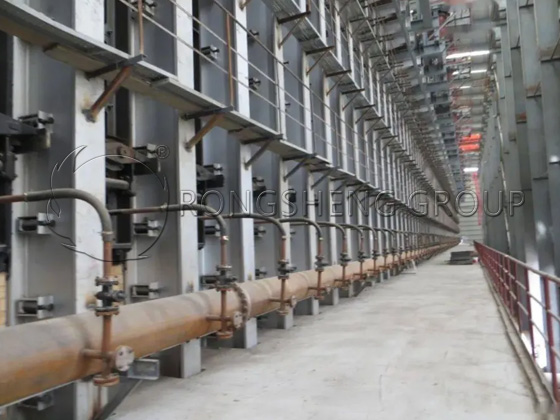
High-alumina refractory bricks offer good application results, high temperature resistance, and a long service life. They are an important refractory brick product for industrial high-temperature furnaces. It is crucial to understand the production process of high-alumina refractory bricks: various mixtures undergo strict batching and extrusion, and then sintering in a tunnel furnace. High-alumina refractory bricks also have a higher refractory limit than clay bricks and semi-silica refractory bricks, with a refractory limit of 1750–1790℃. Due to their high Al2O3 content and low impurities, the glassy body is less prone to melting, resulting in a higher softening temperature than clay bricks. However, mullite crystals do not form a network structure, leading to a lower softening temperature under load.