Focus on Producing All Kinds Of High Quality Refractory Fire Bricks !
Anchor Bricks for Optimizing the Wall Structure of Industrial Furnaces and Flues
In composite wall structures for industrial furnaces and flues, traditional anchoring bricks commonly suffer from insufficient positioning accuracy and construction misalignment. To address this technical challenge, anchoring bricks have achieved significant improvements through structural innovation.
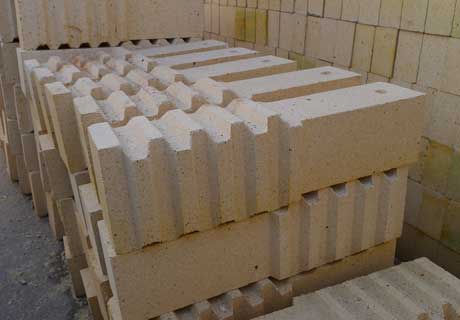
Anchoring Bricks for Wall Structures
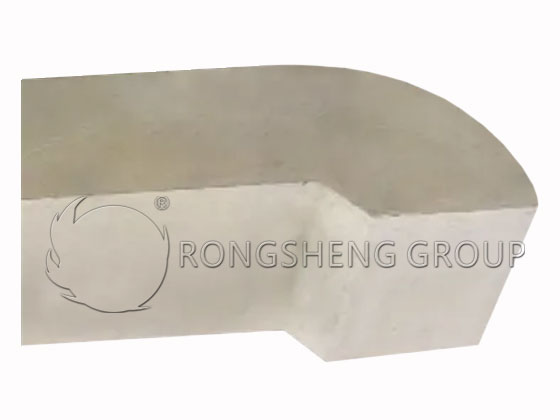
The anchoring bricks feature a cylindrical base design with an array of annular grooves spaced along the axial direction, achieving three-dimensional positioning through this unique groove structure. The core innovation lies in the dual locking mechanism of the end structure: in addition to the traditional pin hole, a U-shaped groove matching the anchor hook is added to the bottom of the same-side end face. This groove is coplanar with the pin hole, forming a double-point constraint structure in the vertical plane. When the anchor hook is inserted, the curved surface of the U-shaped groove forms a surface contact with the hook body, cooperating with the axial positioning of the pin to construct a three-dimensional mechanical interlocking system.
During construction, the operator precisely inserts the anchor hook into the U-shaped groove and then uses the pin to complete the lateral fixation. The annular groove group mechanically engages with the refractory material during casting, effectively eliminating the sliding risk of traditional smooth cylinders. This dual anchoring mechanism forms a rigid connection network between the lightweight refractory brick layer and the heavy casting, resulting in a measured increase in shear strength of over 40%.
Industrial verification has shown that furnace walls using this anchoring brick have a 2-3 year longer maintenance lifespan and a 15% lower heat loss rate. It is particularly suitable for pusher-type furnaces, ring furnaces, and other thermal equipment operating at temperatures between 800-1200℃.
This innovative technology overcomes the limitations of traditional single-point anchor fixing, achieving a leap in building physical performance through geometric optimization. It provides a new technical paradigm for industrial furnace wall structure design and has been successfully applied to the retrofitting of over twenty types of thermal equipment in industries such as metallurgy and ceramics.
Is it acceptable for an anchor brick to break in two after being pushed over while standing upright?
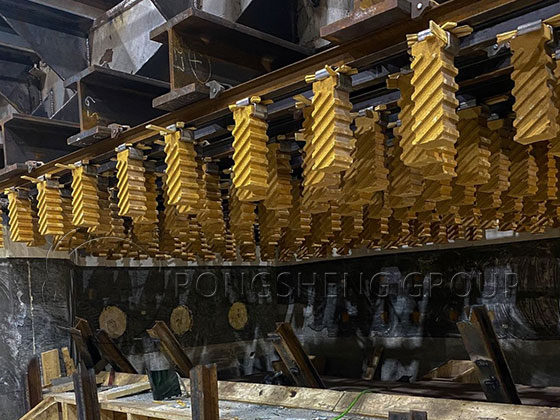
Anchor bricks are a crucial component of modern monolithic refractory linings. Embedded within the lining, they serve a connecting and securing function, connecting and fixing the lining to the furnace shell or supporting steel structure of high-temperature industrial kilns. They mainly include furnace wall anchor bricks, furnace roof anchor bricks, and hanging bricks also fall under the category of anchor bricks. Anchor bricks require high strength and good thermal shock resistance. They are generally made from first-grade or third-grade bauxite clinker, fired at high temperatures, but their long-term service temperature is relatively low. Currently, industrial furnaces are trending towards larger sizes and longer service lives, placing higher demands on their refractory linings. As a vital component, the performance of anchor bricks is even more critical. In particular, new refractory linings utilize integral anchor brick composite linings, requiring the anchor bricks to possess high strength, erosion resistance, spalling resistance, and low creep characteristics, enabling long-term use at operating temperatures above 1500℃.
The production of anchor bricks mainly considers two aspects: refractoriness and tensile strength. Refractoriness is generally not a problem; the most important factor is tensile strength. The strength of sintered refractory products mainly comes from the ceramic bonding between particles within the refractory material. The higher the degree of this ceramic bonding, the higher the strength. The ceramic bonding of high-alumina refractory products is mainly the result of liquid-phase sintering, that is, the formation of a liquid phase in the refractory material at high temperatures promotes particle adhesion and mass migration. The more liquid phase formed, the better the sintering strength, and the higher the strength exhibited in the cold state.
However, cold-state strength and hot-state strength are often contradictory. While a large amount of liquid phase at high temperatures promotes sintering and results in high low-temperature strength, this large amount of liquid phase will reappear during high-temperature use, leading to a decrease in high-temperature strength. The more liquid phase at high temperatures, the lower the high-temperature strength. The temperature at which anchor bricks are used in normal castable linings generally does not exceed 1500℃. If this temperature range is exceeded, it is recommended to use high-purity Al2O3 corundum anchor bricks.
Case 1: A client needed anchor bricks for suspending and then casting the furnace roof during the construction of an aluminum melting furnace. They purchased a batch of anchor bricks from a certain location, without specifying material properties, tensile strength, or compressive strength; only the refractoriness was required. After delivery, the bricks were coated with asphalt paint and expansion joints were prepared. While inspecting the construction, the client, concerned about the unusual shape of the refractory bricks and whether they could withstand the tensile force of several tons, casually picked one up and pushed it over. The entire anchor brick broke in two from the top cross-section. The client inquired about the technical parameters of such anchor bricks and their safety and reliability after suspension. Unable to answer, the client demanded the entire batch of anchor bricks be discarded. The client then contacted our company to inquire why the anchor bricks purchased earlier had broken. The product photos show that the anchor bricks previously purchased by the customer had uneven sintering, exhibiting two levels of color difference, and their tensile strength did not meet the national standard requirements for anchor bricks.
Case 2: A customer in Shanxi, manufacturing castings and forgings, has a 9m³ trolley heating furnace. The furnace roof uses an anchor brick arch suspension system, with a castable thickness of 550mm. The furnace operates at 1350℃, with intermittent operation and shutdown at night. To save costs, the customer assumed that since the furnace walls were cast as a single piece, the anchor bricks only provided tensile support in the middle of the arch and were not a major issue. Instead of using Grade 1 anchor bricks, they purchased Grade 3 anchor bricks. Less than six months after construction and furnace operation, the anchor bricks in the middle of the arch broke, causing the castable to sink by nearly 100mm. The customer called to inquire about repair methods. Therefore, the anchor bricks are crucial for bearing the main load during suspension, and material selection must be extremely careful.
The tensile stress on the cross-section of the anchor brick increases progressively from bottom to top. Furthermore, the tensile stress increases most rapidly within the anchor brick section of the castable refractory layer, reaching its maximum at the interface. In addition to the tensile stress caused by gravity, the anchor brick at the interface also bears significant shear stress. Therefore, it is essential to carefully consider the technical specifications when selecting anchor bricks, or refer to national standards.